

Digital Marketing
Going online is becoming increasingly important in an increasingly digital world. Your brand must be visible, from active social media activity to ranking on Google searches. We Have Digital Marketing Solutions For You.
Visible One is one of the Hong Kong’s leading digital marketing agencies, with a track record of client success and industry knowledge.
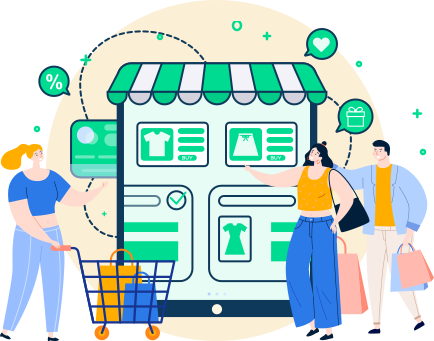
Consumers’ buying behaviour has changed
Now, if someone needs product/service, they will research online before purchase. Thus, your website needs to offer relevant, fresh and high-quality contents.

Increase trust and reputation
By providing relevant and consistent contents in your website, you will be perceived as trusted expert in your field.

Turn your customers into promoters
Use Inbound Marketing strategy to delight your customers. Delighted customers will become your promoters and share your information across their social media.
Our High-End Digital Marketing Services




How it helps you?
Of Consumers Will Learn More About A Product Through Search Engine.
Of Users Believe Their Organization’s Marketing Strategy Is Effective.
Of Companies Say Blog Content Creation Is One Of The Top Inbound Marketing Priorities.

How do you know your website is successful?
We are the Hubspot Certified Partner
We offer all-in-one software for small and medium enterprises in Hong Kong that want to transform their business by providing exceptional inbound marketing and sales services.

WHY INBOUND MARKETING?
In today’s world, the digital age has changed the way people purchase. It’s more important than ever for people to find your company online and not your competition. Nurture your leads and turn them into customers, then give your customers an awesome brand experience so they come back for more. The best way to do that is through an effective Inbound Marketing. Through creating digital growth strategies, your business can promote itself online, helping it to be found by interested prospects, generate demand, engage prospects and closes more deals for your company. But that also applies to every other business. So, in order to stand out from the competition and capture the attention of your ideal prospects, to interact with them and to raise your brand, you need to utilize inbound marketing effectively with the help of a HubSpot Partner Agency like us.
HOW CAN WE HELP?
Visible One is an inbound marketing company in Hong Kong, a certified HubSpot Marketing Agency Partner and we are a live and breathe agency that you succeed online.As a HubSpot Partner Agency in Hong Kong with years of inbound marketing experience, we’ve delivered significant digital growth for numerous clients with our inbound marketing key services such as:
- Content marketing
- Search engine optimization
- Marketing automation
- Lead Nurturing
- Email strategy
- Advertising and PPC
- Marketing project management
- Analytics & reporting
Our team is dedicated to the practice of attracting visitors to our client’s sites and converting them into customers. If you’re unhappy with your current marketing program or aren’t seeing the results you want, then we can help your company with inbound marketing by providing lead nurturing and lead generation services, content marketing and marketing strategy.
WHAT IS OUR PROMISE?
We promise nothing but results-driven inbound marketing service to showcase the best of what your business can offer to customers that yield to your business success.We understand that to convert visitors into delighted customers is not a simple goal when you don’t have the right team with the right tools. As inbound marketing company in Hong Kong, we’ll create for you an effective inbound marketing methodology that attracts, entertains and informs the market about your brand through targeted content. We use HubSpot as the platform to build marketing and sales campaigns. We can scope, implement and ensure you get continued value from our inbound marketing service.As lead generation specialists that solve lead generation problems using the inbound methodology, everything we do is committed to help you capture sales qualified leads.

Engage Your Customer From First Click to the Latest Purchase
As a leading eCommerce development company, we have designed and developed eCommerce stores on a wide variety of platforms, as well as building bespoke websites to meet very specific customer needs.

ATTRACT
Make prospects aware of your company and the services and products that you offer.
By providing ideal prospects real-value content through blog on your website, or social media marketing and search engine optimization at the right place, and at the right time, you are proving them helpful answers and solutions to their business problems and demonstrates your understanding of their business.

CONVERT
Obtain contact information of website visitors and convert them into leads and sales.
Once the right visitors have been attracted to the site, the goal is to convert them into leads by offering something of value such as eBooks, whitepapers, blog posts, webinars, etc. This “something of value” should come with calls to action to encourage prospects to be willing to relinquish their contact details on a landing page.

CLOSE
Nurture leads with appropriate content to transform them into paying customers.
In moving your prospects down the sales funnel, it is the make-or-break moment for your inbound marketing efforts. In this stage, it is to nurture each lead interest toward making a purchase and transform them into customers by providing relevant information that addresses each customer’s pain points and concerns. This process is associated with lead scoring to allow you to focus you precious sales resource.

DELIGHT
Provide attentive customer service and show appreciation for the people who purchased from you.
Once the sale is closed, it is not the end of the relationship with your customers. Your goal is to continue to engage, show and delight your customers that you still value them. Highly targeted content, interaction on social media, and marketing automation are some of the most effective strategies you can use to achieve this.
WhyChooseUs
Visible One is a certified HubSpot Marketing Agency Partner that offers strategic inbound marketing services that support across the entire customer lifecycle. As an inbound marketing agency in Hong Kong, we’ve helped businesses of all sizes to grow with strategic inbound marketing.

INNOVATIVE & RESULTS-DRIVEN
Our marketing tactics are created with results-driven marketing plan to achieve your goals. We work alongside you to understand your business and your customers and use these insights to drive opportunities for growth.

CUSTOM INBOUND MARKETING SOLUTION
We design a bespoke and clear inbound marketing strategy according to your business goals, taking a deep dive into your buyer personas, your competitors and your areas of opportunity that will drive your business forward.

INBOUND MARKETING SPECIALISTS
We understand and value your business as highly as you do. When you work with us, our team of Strategists, Designers, Developers, SEOs, PPCs, Inbound Marketers, Copywriters will help your business succeed.

DEDICATED TO CLIENT SUCCESS
We collaborate with you to define measurable business goals, build your brand and achieve excellence. We pride ourselves on complete transparency and understand your need to prove inbound ROI and business success.
If you have a project and would like to discuss it with us, then please do call us or email us using the form below.